Design
Why there is no timer
The first thing we cut was the clock. Everything the game is now followed from that one decision.
The first build of Alchemess had a timer. It was there for about a week.
It was not a punishing timer. You had ten minutes, the shelves were smaller, and running out just ended the round and showed you a score. Perfectly ordinary. And every single person who played it did the same thing: they stopped reading the labels.
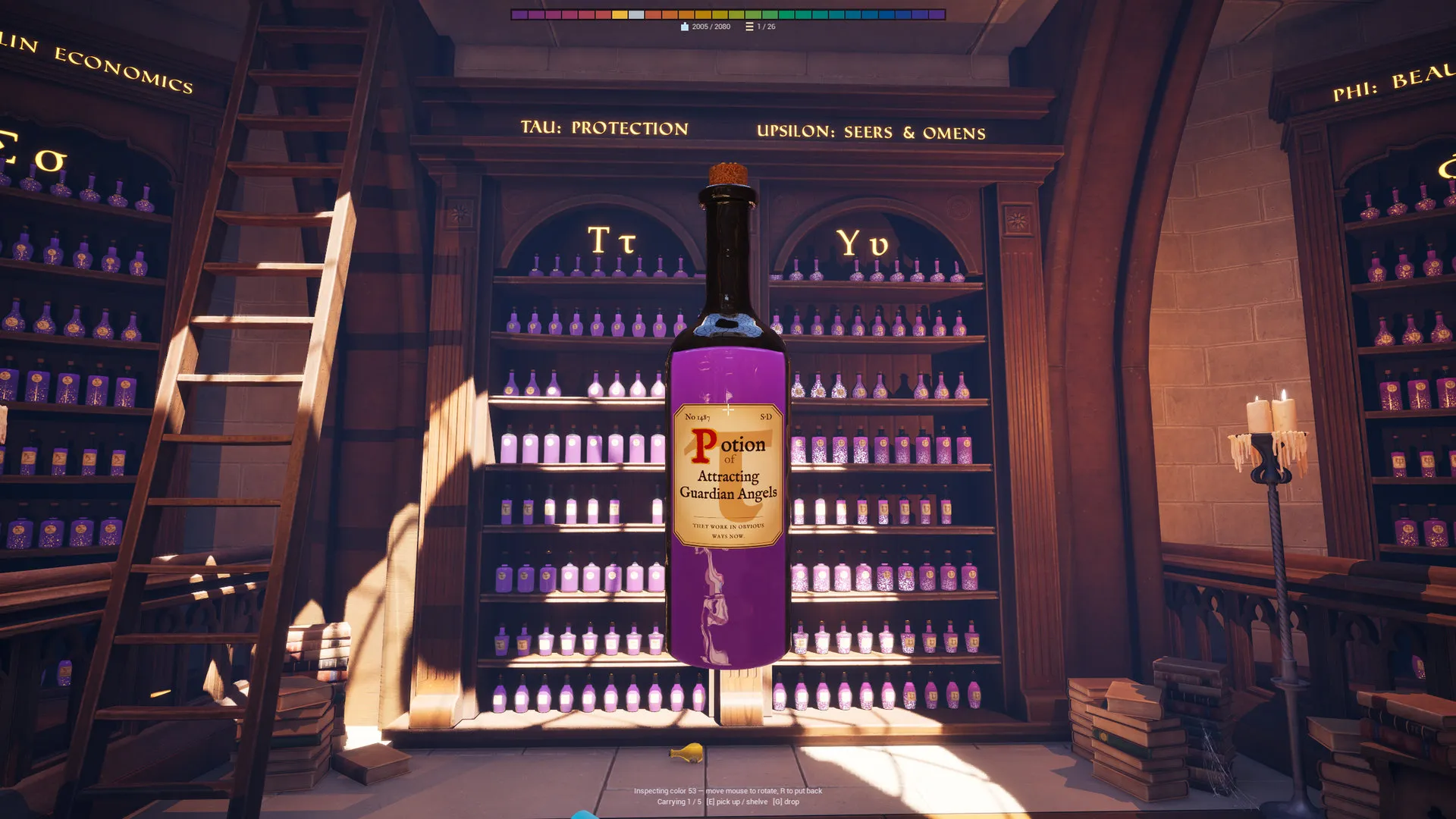
That was the moment the design decided itself. The labels are the game. Every one of the 2,080 bottles is hand-named, numbered and printed on aged parchment, with a watermark carrying its shelf’s letter and a vermillion initial edged in gold. If you are watching a clock, none of that exists. You are looking at a colour and a shape, and the shop might as well be full of blank glass.
So we took the timer out. Then we took the score out, because a score is a timer that has learned to hide. Then we took the fail state out, because there was nothing left for it to do.
What replaces it
Nothing replaces it, and that turned out to be the point.
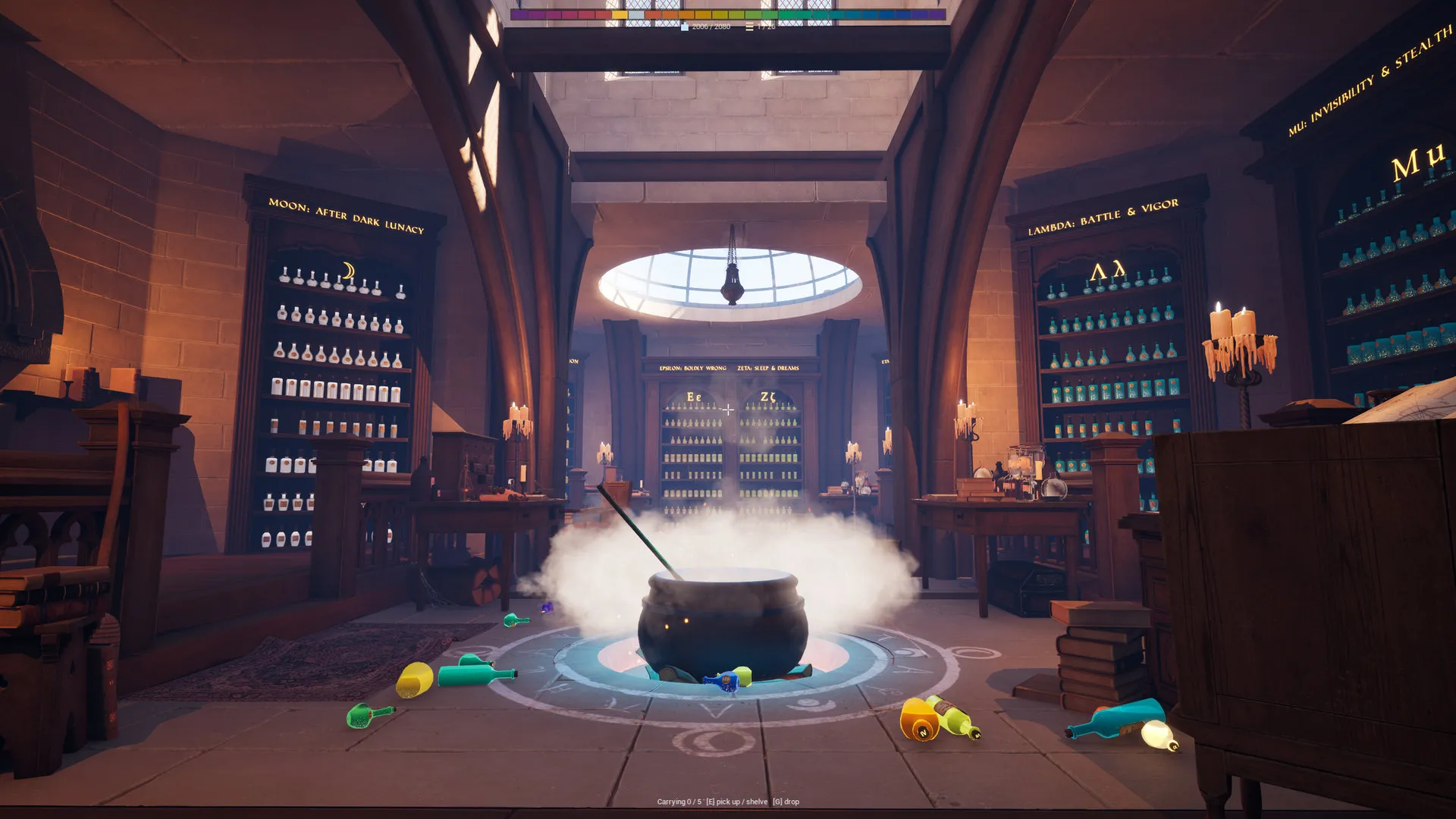
Put a bottle in the wrong slot and there is no buzzer, no penalty, no red flash. The bottle simply sits there, in the wrong place, being wrong. You can walk away and come back to it in an hour. The only thing a mistake costs you is the walk back — which, in a room this size, is genuinely a cost, just not a cruel one.
Put a bottle in the right slot and it locks in with a soft green swell. That is the entire reward, and it is permanent. A bottle you have shelved correctly is a bottle you will never think about again. Two thousand and eighty of those, one at a time.
The shop saves itself every ten seconds, misfiled bottles included. Close the game standing in the middle of the heap and tomorrow you are standing in exactly the same heap. We wanted the shop to still be there rather than reset, because a room that tidies itself while you are away is a room where your work did not matter.
The difficulty modes are not difficulty
There are three of them, and none of them make the game harder in the usual sense. They change how much the shop tells you.
The most generous one stencils a number on every slot, so finding the home of No 1177 is a matter of reading. The middle one hides the numbers and leaves the colours. The last one hides the colours too, until you have earned a shelf back. And then there is Purist, which tells you nothing at all: your eyes, your memory and the map you have built in your head.
None of those settings can make you lose. They only change how much of the shop you have to hold in your own head — which, it turns out, is the part people actually wanted to be difficult.